Monday, April 28, 2014

Exploring the Potential of Assistive Robots.

Frank: Can't you do that super fast?  Robot: Some things take time, Frank. -- Robot & Frank, 2012.

As you know, I've been researching and writing a paper on the topic of assistive robots for older adults living in their homes. The topic caught my interest as I pondered the caregiver shortage and possible solutions.  Well, I'm nearly finished with my paper and presented a poster on this topic last week. 

I learned so much from this process and here are some interesting findings:

  • Older adults are open to the idea of robots performing practical tasks such as managing information, manipulating objects, and assisting with household chores. Most prefer human aid for personal care needs (Smarr et al., 2013)
  • Many expressed preferences for small, creative looking robots with combinations of human-like and machine-like traits. Humanoid robots were the least favored (Wu, Fassert, & Rigaud, 2012).
  • For older adults, robots must fit seamlessly into living environments because home is a central, interconnected hub where people, products, and activities come together (Forlizzi, diSalvo, & Gemperle, 2004).
  • Very few studies have considered socio-demographic variables on studies of robot acceptance and usage (Flandorfer, 2012).
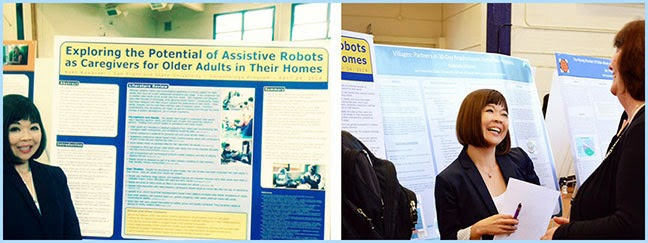
Presenting my poster at a graduate studies showcase. (Photo on right: by D. Houlton)
Despite fear and hesitancy towards the idea of assistive robots, those who participated in user studies had mostly positive experiences, and many suggested that they would not mind having such devices in their homes. In a few studies, however, older adults stated that robot usage represents loneliness, frailty, and isolation. Thus they would not utilize robots. 

Presently, there are ethical concerns, cost of robots, and lack of availability. These are all important issues to consider. Furthermore, there is a general lack of user studies with older adults.  I believe that robots have potential to provide assistance, but I also believe that there are so many areas that need to be addressed in order to move forward.  On a positive note, there are many new technological products being created for older adults to live safely and independently in their homes.

Thank you for visiting my blog. If you have questions or comments, I would be interested in hearing from you. Less than one month until graduation! Woohoo!!!

Sunday, March 9, 2014

Robots and Older Adults: Prevalence of Ageism.

"Age is an issue of mind over matter. If you don't mind, it doesn't matter." -- Mark Twain

Time flies when there's so much to do, and it's been awhile since my last post! I have been researching articles for my paper, and slogging away through the initial draft process. It's been a challenging experience, but I've been learning so much!


Although there are many articles in the area of assistive robots, they are either focused on technical aspects, or emphasize views of designers, technologists, and other parties who are not the intended end-users. I'm not suggesting that their views are unimportant, yet I think it's perplexing that the most relevant persons, namely older adults, have played only a minor part in the conceptualization and testing of products. Then, I read a few mind-opening articles: one written by Peine, Rollwagen, and Neven (2014), and the 
other written by Neven (2010).

Me, as a chubby-cheeked 3-year old, posing with relatives.
Peine et al. wrote about how stereotypical assumptions of older adults leads researchers and designers to create products that lack meaningfulness, thereby overpowering older adults' potential to be co-producers in creating innovative products. Moreover, Peine et al. call critical attention to the paternalistic view in gerontechnology where older adults are expected to be the passive recipients of products. 

Likewise, Neven found that older participants in robot user-studies saw themselves as test usersrather than old people that such products were designed for. Many in Neven's study viewed themselves as healthy and active, thus they felt they were assisting research to help others who were weak and socially isolated. The authors in both articles point to the negative ways of how assistive products are positioned -- as aides for older persons who need help due to age-related declines, rather than as useful devices for individuals who wish to enhance their independence.

These articles really made me think. If I were the intended recipient of such products, I would be offended by the ageist views that are assumed as fact concerning older persons, such as being tech-averse, ignorant, or slow and decrepit. It makes me understand one reason (out of many) for the discrepancy between the availability of robotics products and the lack of older users. There's still more I can say about this issue, but I have to get back to writing my draft! Thank you, as always, for visiting. I hope to post again within a few weeks, but please feel free to comment.

Sunday, February 9, 2014

Robots as Caregivers: Is it Unethical?

“Our very lives depend on the ethics of strangers, and most of us are always strangers to other people.” -- Bill Moyers


As I had mentioned in an earlier post, I am exploring the idea of robots as caregivers for older adults and will be writing a literature review as part of my graduate thesis project. I became intrigued by the idea of assistive robots as I pondered the caregiver shortage coinciding with the growing numbers of older adults. Although I don’t think of myself as pro-robot, I don’t believe that the use of robots is completely unethical.

There are arguments suggesting that the use of assistive robots will further marginalize older adults who are disregarded by society. Some declare that robots cannot understand human emotions, and therefore cannot provide the sensitive touch of human caregivers. Others argue that reliance on robots would increase social isolation. These concerns are very important, but the reality is that there is a shortage of caregivers. Robot technology may be one option that can help fill in some of (though not all) the gaps. Robots may even provide respite and assistance to formal and informal caregivers because let’s face it –- caregiving is hard work!

At age 3: Trying to be a lady.
Undoubtedly, social isolation is common among older adults, particularly those with cognitive and physical challenges. I’ve even witnessed it among some older clients I work with. However, social isolation is not a new phenomena, and it has existed prior to technological advancements. Alternatively, it may be possible that robots can help enhance social interactions and connections with family and friends.

Furthermore, if we are truly concerned about social isolation, all of us can make efforts to support older persons. It’s easy to criticize the use of robots, but are we all willing to take steps (big and small) to reduce or eliminate the need for such devices? Are we willing to pay more to ensure fair compensation for caregivers?

Many loose ends exist at this point, and I’ve only begun my research. Personally, some of my issues regarding robots include cost and availability. As I’ve been combing through the literature, presently it seems that care robots are expensive and unavailable to the masses. But for now, I will conclude with one final thought -- perhaps asking older adults about their views and wishes on this subject matter would be an ethical consideration. Thank you for reading my post, and please share your thoughts and comments!

Sunday, January 26, 2014

A Sense of Purpose.


"You are never too old to set another goal or to dream a new dream." -- C.S. Lewis

Recently, I saw the movie Nebraska, in which an older gentleman named Woody Grant receives a sweepstakes letter suggesting he might be a million dollar winner. Woody's family warns him that this is a scam; nevertheless, Woody determines to do whatever it takes to get to Nebraska to claim his prize (even if this means walking all the way from Montana).
Father, mother, brother & cousin.
Woody’s indomitable spirit made me think about the concept of ikigai, a Japanese word that roughly translates as something to live for, or reason for being. For Woody, whose aged body and mind reveal the long-term effects of alcohol abuse, getting to Nebraska wasn’t just about the prize. Rather, it was about striving towards a significant, larger-than-life goal. Getting to Nebraska represents Woody's ikigai.
Ikigai is integral to life satisfaction no matter what age you may be. Even so, it is more challenging for older persons when goals are besieged by a myriad of obstacles such as health issues, loss of loved ones, and financial difficulties. My own immigrant parents have had many dreams, and also experienced great disappointments due to illness, loss of income, and family discord. Despite hardships, my parents courageously pushed themselves to get up everyday and to move forward. 
My Buddhist mentor Daisaku Ikeda, who turned 86 this past January, states, “This lifetime will never come again…to live without regret, it is crucial for us to have a concrete purpose and continually set goals and challenges for ourselves…” Are we ever too old for dreams? For me, the answer is no, but I would be interested in hearing your thoughts and comments. Thank you for taking the time to visit my blog.

Wednesday, January 15, 2014

When life gives you lemons...

"...You may be given a load of sour lemons, why not try to make a dozen lemon meringue pies?" -- Maya Angelou

The other day, a neighbor gave us lemons from her lemon tree. It was perfect timing because I had intended to make lemon bars to honor the 4-year anniversary of my father's passing on January 15 (which is today). Why lemon bars? Well, lemon pie was my father's favorite dessert, and occasionally, I would bring this treat when I visited father in the nursing home. When lemon pie wasn't available at the bakery, I would bake lemon bars to substitute. Luckily my father did not seem to mind, and I can still visualize the the joy on his face as he enjoyed his lemony delight. With the progression of dementia, father's vocabulary became limited. Interestingly, lemon pie was one of the few phrases he never forgot, and he often reminded me to bring his favorite treat on my next visit. As time went on, I brought lemon bars more often than pies because it was simple to make, but nonetheless delicious. Father's favorite part was the tart, lemony filling.

My father, mother and me next to the lemon bar (made with love).
My paternal grandfather was an actor who provided for his large family through operating a neighborhood bakery. Not surprisingly, my father grew up eating sweets and continued to enjoy them throughout his life. My grandfather's bakery in Japan did not have lemon pies, so it seems father discovered them when we moved to the U.S. I never asked him why he loved lemon pies over every other sweet, but it is one of the details about my father that always makes me smile. The well-known adage suggests, "when life give you lemons, make lemonade." In my case, I make lemon bars. In doing so, January 15th feels more bearable as I reminisce about the many happy moments I shared with my wonderful father.

Saturday, December 28, 2013

An Octogenarian Poet.

"...why are we older than people we used to think were old?" -- Ralph Lane, Jr.


Childhood friends.
This morning, as I lay in bed recovering from a bad cold, I remembered the wonderful poetry of the late Ralph Lane, Jr., a retired professor who began publishing prose and poetry in his eighth decade.  As a former community college student, I was fortunate to have been given the opportunity to design one of Mr. Lane's poetry chapbooks, Peripeteia. This experience remains as one of my most favorite projects. Despite battling health problems, Mr. Lane had goals and ideas for future poetry books. At our very last meeting, he had asked whether I would be interested in working with him again. I was honored and said yes, but sadly, he passed away before we could collaborate once more.

In his poems, Mr. Lane beautifully describes the experiences of living as an older person in the world - both the challenges and the joys. As someone who is not as old (yet), reading his words helps me to respect the experiential nature of aging. Here is one of Mr. Lane's poems from his chapbook:

What's Your Choice? 
In tandem with Charlie Brown's Grandpa trying
to solve one of life's great mysteries, why are we
older than people we used to think were old?
Simple answers surface readily, exercise and diet
leaving unexamined a more profound puzzle.

Why have we been granted this dozen years or more 
beyond the biblical allotment, beyond our fathers' earlier demise?
What have we done, what are we doing with that time
have we sown in rich soil revealing so much,
have we multiplied the talents given us gratuitously?

Have we squandered the time,
frittered it away, 
because we see
no end in sight, and
to whom or what are we accountable,
to chance, to intelligent design,
to whom/whatever we believe moves it all?

His words give food for thought, and continue to inspire me. Thank you for taking the time to read this. Best wishes for a healthy, happy 2014!

Thursday, November 28, 2013

Grateful.

Gratitude is the key to unlocking a more open and rewarding perspective on life. Feelings of appreciation are always accompanied by the elevation of one's state of life and the broadening of one's perspective. And, the more our life expands, the more profound our sense of gratitude becomes, to the point where we can feel appreciation even for the problems we face in life. -- Daisaku Ikeda

Awhile back when I was a caregiver for my father, I noticed that some people would show their support by sympathizing with my plight. “Oh, it must be so hard for you.” “I’m sorry that you have to endure this.” “How horrible that your father is no longer able to walk nor care for himself.” “You look tired, you poor thing!”

Alternatively, others congratulated me for encountering struggles, and encouraged me to win over my obstacles. Initially, I wanted sympathy and felt comforted by those who felt sorry for me. As I overcame my internal challenges, I found that sympathetic remarks, though well meaning, hindered my growth. In my weakness, I sought a “cushion” to protect me from reality, but I came to realize that the idea of security is an illusion. The truly compassionate were those who were strict and urged me to plow through my difficulties. Furthermore, those who criticized me turned out to be my “best friends” because their words aroused my determination to create a happier life for my family. Likewise, Nichiren states, "...it is not one's allies but one's powerful enemies who assist one's progress ('The Actions of the Votary of the Lotus Sutra,' WND-1, 770)."  

My little ones!
On this Thanksgiving Day, I am grateful for my husband, my mom, my late father, my feline “babies,” my friends, Sensei, my Buddhist practice, health, and an opportunity to further my education. I am especially grateful for the hardships I’ve had as a caregiver: the lonely, sleepless nights; uncertainty of my father’s health; family conflict; financial hardships. I’m most appreciative, however, to those who shunned me and accused me of being an uncaring daughter. Believe it or not, the harshness of some peoples’ attitudes became nourishment for spiritual growth.

"The struggles we face might range from the apparently mundane (summoning the energy to take out the trash or to write a letter to a relative) to the vast (campaigning to ban nuclear weapons), but the essential challenge is the same. It is to overcome our own weakness, fear or inertia in a given moment and take action for the sake of the happiness of ourselves and others (SGI Quarterly, July 2006)." With this sentiment, I am sincerely grateful to you for visiting my blog. Have a wonderful Thanksgiving, and enjoy every moment!

Wednesday, November 20, 2013

Robots as Caregivers?

A little while back, I submitted a proposal for my Master's thesis project which I will start early next year. It took me awhile to decide on my subject matter, but after researching various interest areas, I decided on the topic of robots as caregivers. Some professors were intrigued by my decision, while others were disturbed by it and flatly refused to support me. Nonetheless, I became interested in this topic due to current articles written on the shortage of caregivers. There are greater numbers of older people who need caregivers in relation to the numbers of caregivers available. Why not look at alternative ways to meet this need?

This past week, I had a chance to watch Robot & Frank on DVD. This film came out last year, but I only heard about it recently from my gerontology classmates who, upon learning of my thesis subject, urged me to watch this film.

Without giving much of the plot away, this story is about Frank, an older man whose behavior suggests signs of cognitive decline (i.e., unkempt home, rotten food in the refrigerator). His son Hunter, who makes long, weekly treks to check up on his father, is unsuccessful in trying to get him tested for dementia. Frank insists everything is fine, and not knowing what to do, Hunter buys a caregiving robot to help ensure his father's safety and wellbeing. Having the robot look after Frank provides piece of mind for Hunter who struggles to make time for his own children. To make a long story short, Frank eventually develops a friendship with the robot that serves as a caregiver and a non-judgmental confidante. In the end, after a series of risky events (watch the film to find out!), Frank deactivates the robot and eventually moves to an assisted living facility.

I enjoyed watching this movie; the relationship between Frank and the Robot was particularly touching. Although robots cannot replace the human touch, this film made them seem like practical options that might work for some people.

Me and my brother on a boat.
Technology cannot resolve all our issues, but perhaps we can utilize robots to provide respite and lighten the load of caregivers who are overworked, underpaid (or unpaid), and undervalued. If robots can help with various tasks, caregivers may also have some time to do what they need or want to do.

Incidentally, there is a recent article on BBC News online titled, 'A robot is my friend': Can machines care for the elderly? This story examines the idea of robots as caregivers. I am curious about what you think. Do you think robots as caregivers is feasible, or do you think it's a ridiculous idea? What are some alternative ideas to resolve the caregiver shortage? Thank you for reading this post!

Wednesday, November 6, 2013

Turning Poison into Medicine.

Chanting for wisdom.
When we care for others, our own strength to live increases. When we help people expand their state of life, our lives also expand. Actions to benefit others are not separate from actions to benefit oneself. Our lives and the lives of others are ultimately inseparable.  -– Daisaku Ikeda

Caregiving is hard work, and so much of past articles I’ve read emphasized the negative effects and challenges. As a former caregiver (and somewhat of a hypochondriac), I used to believe that caregiving stress would lead to premature aging via the shortening of my telomeres. On a positive note, recent news suggests that caregivers are healthier and live longer.

When my father became ill, the duties of caregiving were completely new to me and I felt inadequate as I tried my best to assist him.  As I had mentioned in a previous post, I was initially resentful of my situation, and would often daydream about how I would run away. Some criticized the decisions I made regarding my father's care, and I felt very lonely.  In the beginning, I spent “free time” crying and chanting Nam-myoho-renge-kyo, my Buddhist mantra, in order to manage the responsibilities.  

I chanted a lot during the caregiving years, and this helped to strengthen my resolve on days when I felt like falling apart.  My Buddhist practice also helped me to bring forth compassion and wisdom to make sure that my father was well cared for.  What was more amazing: caregiving became the springboard for tremendous personal growth.  I began to understand that the happiness of others is not separate from my own - No effort is ever in vain. This realization led to deeper happiness and appreciation, especially for the difficulties.  Eventually, chanting put me “in rhythm” with my environment so days flowed more smoothly, and it helped me to be flexible when situations were unpredictable. 

Through harnessing the power of Buddhist practice, I gained: compassion, patience, confidence, hope, sensitivity, affection, open-mindedness, flexibility, sense of purpose, spiritual growth, inner strength, and gratitude. I used to think caregiving was an obstacle to my happiness, but it became the cause for greater fulfillment.

I would like to express thanks and gratitude to all the noble caregivers who are working tirelessly everyday to make sure that loved ones are well cared for. Nichiren states, "...where there is unseen virtue, there will be visible reward (WND, Vol 1, 1278, p.907)."  This quote applies to all of you.  May your lives continue to shine brilliantly!

Friday, October 25, 2013

Together in Spirit.

Like the ocean that remains calm in its depths even when waves rage over its surface, and like the sun that continues shining on high even during storms, we can at each moment create value and develop our state of life, enjoying our existence to the fullest in times of both suffering and joy. -- Daisaku Ikeda

Me and my father.
Today is my father’s 81st birthday. Tonight we will have cake in his honor, and chant for his enlightenment and eternal happiness.

In my earliest memories, mother and I would bid father goodbye at the train station as he left on his business trips. Fearing that he wouldn’t return, I would cry and beg him not to leave. Seeing me cry would always make mother cry. Thus, it was a happy reunion when father returned home. When he passed away over three years ago, I used to imagine that he would walk through the front door and announce that he was home. I would also visit places we used to frequent, and hoped that he would appear. It took awhile to get used to the reality that he was no longer here.

My father was a kind, sincere man. He came from a family of six boys, and he was very pleased when I was born. A doting father, he encouraged me to pursue all my interests. I was fortunate to have had many opportunities because of my father, and the best way I can show my gratitude is to live the happiest, most contributive life.  

Looking back, I think about the hardships father must have faced as an immigrant in the U.S.  Early years were filled with financial instability. Being a Japanese man, he was not in the habit of expressing worries and frustrations, and I never realized the depths of his struggles. Regardless of difficulties, father made sure we had everything we needed.

As my father aged, he grappled with various health conditions along with vascular dementia.  As an effect of the dementia, father became openly emotional and no longer held back his tears. For example, I remember thanking him for being such a wonderful father. Hearing my words, he was overcome with emotion and started to cry.

Although the latter years were challenging, my father and I had the opportunity to spend lots of time together. This was a rare gift, and I would do it again in a heartbeat. These days, I believe that my father is with me in spirit. Knowing this makes me feel braver as I strive to overcome life's challenges.

Thursday, October 17, 2013

When the Onion Ring Betrays You.

Health food may be good for the conscience but Oreos taste a hell of a lot better. -- Robert Redford

In a recent class assignment, we conducted self-experiments to understand age-related changes to the senses and to mobility. One particular exercise that stood out for me was the eating simulation where I tried to eat unsalted crackers without using my teeth.  I put the cracker in my mouth and tried to figure out how to break it down in order to swallow.  It took awhile for the cracker to become soft enough to swallow without choking, and by the third cracker, I became impatient and tried to “chew” using the roof of my mouth and my tongue.  This was not a fun experience, and it made me realize how frustrating it must be when age-related changes affect activities that were once pleasurable.  In older adults, eating could also pose potential hazards such as choking.  A second exercise was to simulate the changes to our senses of smell and taste. While being blindfolded and having my nose pinched very tightly, I ate different types of foods.  Everything tasted similar and dull, and I couldn't differentiate between an apple and a potato!

These exercises made me empathize more with older persons who profess to not enjoying eating.  When senses are duller and eating is cumbersome due to dentures, tooth loss, and/or reductions of saliva (and a host of other reasons), I would probably feel the same way.  Having a nice meal, however, is important to the soul.  When unable to fully savor food, life can become lackluster.  More importantly, you could miss out on important nutrients.

Mother holding a sleepy infant.
While on the topic of food, eating and cooking are among my mother’s greatest sources of joy.  Now aged 85, she is beginning to experience physical difficulties when she eats foods that her body can no longer process.

For example, mother had a gout flare-up last Friday.  She is normally active, but having gout makes walking a miserable, nearly-impossible ordeal.  Mother is not a big meat eater, but she loves fried foods! The neighborhood burger restaurant makes the best onion rings (crispy fried batter, and the perfect amount of salt!), and it is definitely a favorite.  Unfortunately, eating too many onion rings made her body rebel.  Her physician (often) tells her to give up certain foods, but she giggles and gives him a look of innocence.  I have been monitoring what she eats more than before, but I don't enjoy being the food police.  To hasten the healing, I made sure that mother ate a clean, simple diet of mainly grains and light vegetables.  

By Sunday evening, mother broke down and cried hysterically.  She was frustrated and accused me of not letting her eat anything. Actually, she was eating food…just not the kind she often craves.  Nonetheless, I felt like a mean daughter.  On the one hand, I understand her frustration – I would be upset, too.  On the other hand, eating certain foods can lead to painful consequences. Is there a winning resolution?

I don’t want to pretend to be the “expert” because I have yet to experience significant age-related changes.  Hopefully mother will forgive her daughter, the tyrant.  Now, I am curious about you.  Have you had any noticeable changes to your senses or physical functioning with age?  Has it led to a greater understanding of what elders before you may have gone through?  As always, I appreciate your comments. Thanks so much for reading my blog!

Monday, October 7, 2013

Connection between Disparity and Well-being.


“The community which has neither poverty nor riches will always have the noblest principles.” – Plato

Recently, for an Aging and Social Policy class, we were assigned to view various TED Talks and reflect on the messages contained in these presentations.  One particular presentation by Richard Wilkinson titled, How Economic Inequality Harms Societies, made me reflect deeply on how inequality connects to health and wellness.  As I had mentioned in an earlier post, the usual factors that contribute to wellness in aging include social support, diet and exercise, stress management, and genetics.  But, Wilkinson reveals data suggesting that economic inequality within a country affects a host of issues including literacy, health, mental illness, crime, infant mortality, and life expectancy!  We don’t often discuss the far-reaching effects of inequality in everyday conversations (although I believe more people are discussing this issue today).

Watching Wilkinson's presentation made me think about a cultural anthropology project in school from two years ago.  For the project, I interviewed an American elder and a Japanese elder to understand cultural differences in experiences and attitudes toward life, aging and happiness.

When I asked the Japanese elder, Chika* (75 years old), what she believed was a vital ingredient to happiness and well-being, she answered, “Not having many differences in financial status is the most important aspect to well-being.”  This was not an answer I expected to hear, but it left a lasting impression.

My mother and my brother.
Chika elaborated by stating that financial disparities lead to both real and perceived social disparities, which is one of the greatest sources of unhappiness for people. Chika was an atomic bomb survivor from Hiroshima and talked about how everyone was extremely poor after the War, yet there was unity in spirit.  Position and status mattered very little.  In discussing her present circumstances, Chika expressed gratitude for being able to live in Northern California, an area rich with a wide variety of resources.  She stated, “There are so many problems in this world, but we are all very lucky to be here.” Nonetheless, Chika believes that the growing income gap between people in the U.S. is contributing to an unhappier, unhealthier society.  

Her comment makes sense to me today as I study aging and social policies in school, and work with older adults who live well below the poverty level.  Thus, I see the adverse effects of inequality in the lives of many older adults.  So…I would like to know what you think about this topic?  Do you agree that inequality is as damaging as suggested?  Would love to hear your thoughts, and as always, thank you for visiting my blog!

*Chika is a pseudonym